Witness to a Rebreather Fatality
In March 2008, during what should have been a routine charter dive off Hillsboro Beach, Florida, I found myself kneeling at the back of a dive boat administering emergency oxygen and CPR to another rebreather diver.
This article is not a formal accident investigation. It is a personal account, written from the perspective of someone who was present, assisted in the rescue response, and later considered what the accident might teach other closed-circuit rebreather divers.
Some details necessarily involve interpretation and speculation. The purpose is not to assign blame. The purpose is to reinforce several lessons that rebreather divers already know, but sometimes fail to treat with the seriousness they deserve.
The diver who died was experienced. The boat had unusually capable people aboard. The response was immediate, organized, and competent. Even so, the outcome could not be changed.
That is the part of the incident I have never been able to dismiss.
The Setting
The charter plan was a light technical wreck dive followed by a reef drift dive. Several people aboard held instructor-level qualifications, although none were acting in an instructional role. The captain was an open-circuit technical diving instructor and a DAN Diving Emergency Management instructor. The divemaster was a CPR instructor. I was aboard as an experienced technical CCR instructor, and there was also a non-diving rider who was an open-circuit technical instructor.
The diver who later died was an experienced open-circuit instructor and semi-closed rebreather instructor who had recently received a closed-circuit rebreather instructor rating.
The first dive was uneventful. At the end of that dive, another diver dropped a bailout cylinder during exit. After the other divers were back aboard, I made a short bounce dive during the surface interval to recover the cylinder.
The second dive was a normal reef drift dive. Teams entered one at a time as the boat positioned over the reef. Each team descended promptly, with one diver towing the dive flag. The victim and his buddy were the last team to enter. My buddy and I had delayed our own entry to extend my surface interval to account for the unplanned bounce dive.
Shortly after the final team entered the water, I heard the call: “Emergency.”
The Recovery
The divemaster entered the water and brought the unconscious diver to the dive platform. The diver was extremely blue, more so than I had observed in other drownings. There was some foaming from the mouth, but no blood.
Several of us tried to bring him aboard. He was a large man, and he was still wearing his rebreather. I was concerned that the mouthpiece might be open and that the unit could flood, causing him to sink. I reached the breathing hoses and found that the DSV was closed.
We could not get him into the boat fully geared. The rebreather was cut free and left drifting while we continued the recovery. Even after the equipment was removed, it took several people to bring him aboard.
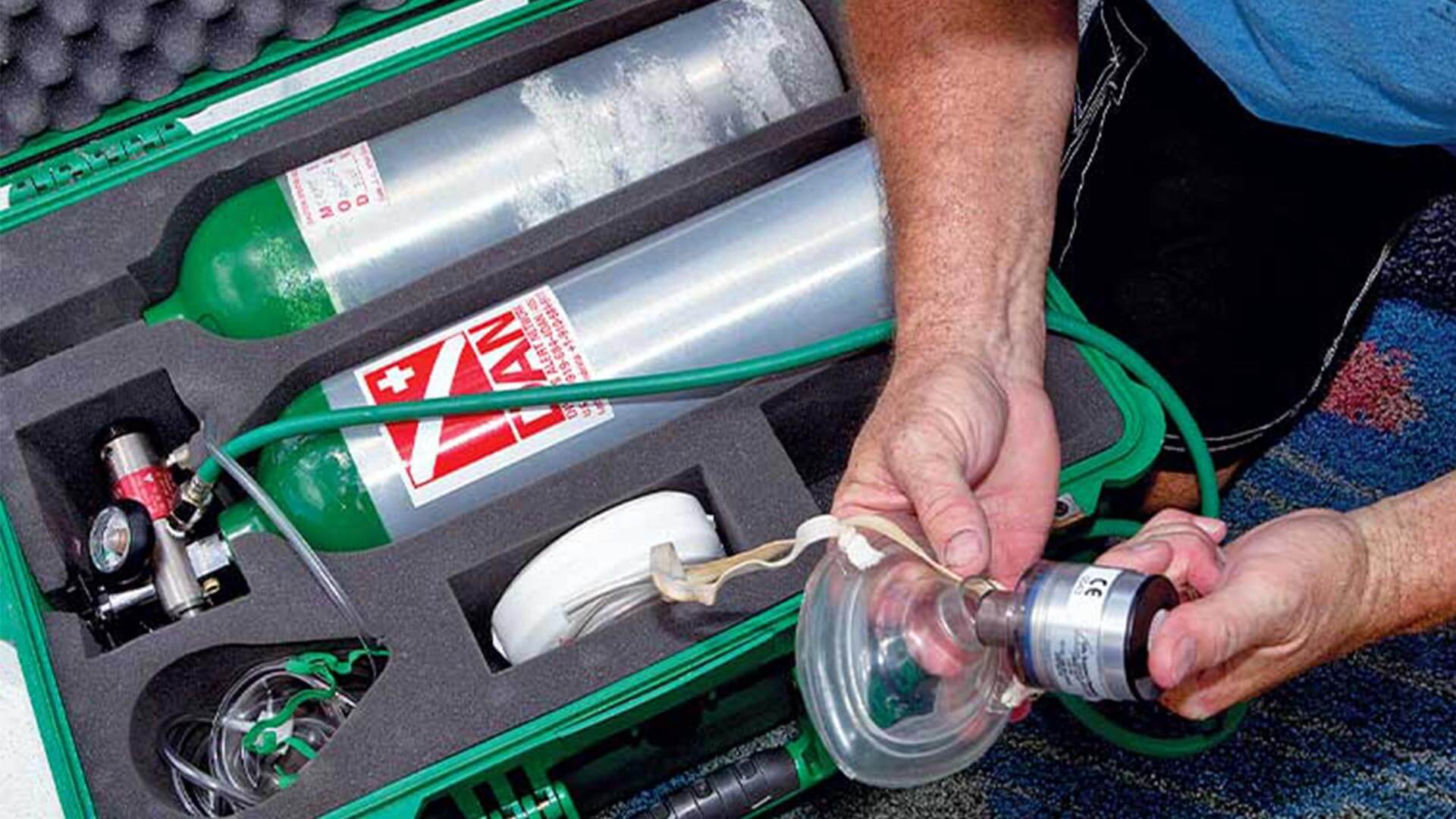
CPR was started immediately, and oxygen was administered with a bag valve mask. His color improved, but there was no meaningful response. The boat was close enough to the inlet that the captain chose to proceed directly to shore rather than transfer the victim to a marine police boat. CPR continued until EMS took over at the dock. He was transported to the hospital and later pronounced dead.
The time from the beginning of the emergency to transfer of care at the dock was about thirty minutes.
What the Equipment Suggested
The fully closed-circuit rebreather (CCR) was recovered roughly an hour after the accident.
The configured gases were normoxic trimix diluent and oxygen. The diluent valve was open and the cylinder was more than half full. The oxygen valve was closed tight. The oxygen gauge showed zero, but the oxygen cylinder itself was also more than half full.
The off-board bailout cylinder was full, but its valve was closed and the second stage was stowed. The regulator was also disabled because the DIN first stage was not fully screwed into the valve, and the regulator had flooded.
The electronics showed low oxygen alarms, with a loop PO2 of 0.07 ATA. The heads-up display was configured to show actual PO2 readings from the three oxygen sensors. The rebreather’s electronics were configured to shut down automatically after two minutes when the unit was out of the water.
Taken together, these facts strongly suggest that the diver entered the water without completing essential pre-dive checks, without confirming that the oxygen valve was open, and without having functional off-board bailout immediately available.
A Plausible Sequence
The exact sequence will never be known. The following is only a reasonable scenario that fits the available information.
The diver completed the first dive without incident. At the end of the first dive, he may have done something common to semi-closed rebreather divers but unnecessary for CCR diving: he closed his onboard gas supply valves.
Before the second dive, he apparently did not complete a written checklist or a meaningful pre-breathe. A proper pre-breathe would have revealed that the oxygen valve was closed. The two-minute electronics shutdown setting also suggests that he was not routinely doing a three-to-five-minute pre-breathe.
When called to enter the water for the second dive, he just placed the mouthpiece in his mouth and jumped without confirming the CCR was ready-to-dive.
During descent, he would have discovered that the diluent gas supply was off and opened the diluent valve because it would not have been possible to descend and breathe from the loop without adding diluent. That would explain why the diluent valve was later found open. But the oxygen valve remained closed, perhaps overlooked due to the task loading of the descent and because semi-closed rebreathers do not use a separate oxygen cylinder.
At depth, the increasing ambient pressure and residual oxygen in the loop and hoses would have temporarily delayed the onset of hypoxia. His buddy, slowed by the flag line, reached the bottom moments later. The victim gave an “OK” signal. The buddy then turned attention to managing the flag line.
At some point very shortly afterward, the victim became aware of a low PO2 condition, either by checking the HUD, seeing a HUD warning, or looking at the handset. He closed the mouthpiece and began swimming toward his buddy.
When the buddy looked up, the victim was moving toward him with the mouthpiece out and reaching for the buddy’s bailout. The buddy began to deploy bailout, but the victim lost consciousness beside him. The buddy immediately brought him from approximately 50 feet to the surface and alerted the boat.
Hypoxia Does Not Give Much Time
A loop PO2 of 0.07 ATA at the surface would increase under pressure. At about 50 feet, the pressure effect would make that loop roughly equivalent to a PO2 around 0.18 ATA. That is mild hypoxia, roughly comparable to the reduced oxygen exposure people routinely tolerate in a pressurized commercial aircraft cabin, and would not normally cause immediate unconsciousness by itself. However, underwater exertion, CO2 retention, and task loading stress can sharply reduce useful time and judgment.
At 0.18 ATA, the victim had several theoretical options. He could have gone to onboard open-circuit bailout. He could have used off-board bailout if it had been functional and accessible. He could have opened the oxygen valve. He could have performed a diluent flush if appropriate to the situation. Instead, he went off a breathable loop and began swimming toward his buddy, rapidly consuming his remaining physiological oxygen reserve. At lower PO2 values, consciousness will be lost in under a minute and often as little as 15 seconds.
Was going off the loop and failing to attempt bailout the result of task loading or panic? Was it a reversion to open-circuit recreational diving habits? The answer is unknowable.
Rebreather divers must not depend on solving a life-threatening oxygen problem after it begins; it must be prevented from happening in the first place.
Rescue May Not Be Enough
One of the sobering facts about this accident is that the response was unusually strong.
The victim was immediately brought to the surface. The boat crew and passengers included people with substantial emergency training. CPR and oxygen were started promptly. The boat went directly to EMS. The entire response was fast and competent.
It still was not enough.
In a hypoxic rebreather accident, the fatal injury may occur before the victim reaches the deck. Brain damage begins to occur rapidly at the onset of severe hypoxia, with noticeable cellular injury starting in as little as 1 to 2 minutes. Irreversible brain damage becomes likely after roughly 5 minutes of oxygen deprivation. By the time CPR begins, the outcome may already be determined.1,2
This is why CCR safety depends so heavily on prevention, routine discipline, and immediate bailout readiness.
The Lessons Were Not New
Nothing about this accident was novel. That may be the hardest part of it.
- Use a written checklist before every CCR dive.
- Do a real pre-breathe before every CCR dive, at least long enough to validate the loop setpoint is maintained.
- Confirm that both valves are open and indicated cylinder pressures are both stable with brief manual additions.
- Verify that bailout is functional, pressurized, reachable, and ready to breathe.
- Monitor PO2 frequently, especially at the beginning of the dive.
- Practice bailout skills often enough that they remain automatic.
- Do not allow time pressure or boat procedures to replace deliberate pre-dive discipline.
- Maintain physical fitness appropriate for the diving being done.
Responsibility
After a fatal dive accident, there is often a strong desire to assign blame: the instructor, the training agency, the equipment, the boat, the crew, the buddy, the rescuers, the conditions, or the victim. Some of those factors may matter in some accidents. But in many diving accidents, the final safety barrier is the diver’s own discipline.
The uncomfortable questions are the useful ones: Do I use a written checklist every time? Do I pre-breathe every time? Do I personally verify my oxygen valve before entering the water? Is my bailout actually breathable, or merely clipped on neatly? When did I last practice bailout under realistic conditions? Those questions are not academic. On a rebreather, they may be the difference between an enjoyable dive and a fatal one.
References
- Lacerte M, Hays Shapshak A, Mesfin FB. Hypoxic Brain Injury. StatPearls. National Library of Medicine, NCBI Bookshelf. https://www.ncbi.nlm.nih.gov/books/NBK537310/
- Merck Manual Consumer Version. Cardiac Arrest and Cardiopulmonary Resuscitation (CPR). https://www.merckmanuals.com/home/heart-and-blood-vessel-disorders/cardiac-arrest-and-cardiopulmonary-resuscitation-cpr/cardiac-arrest-and-cardiopulmonary-resuscitation-cpr