Porsche Taycan Charging Explained
Real-world Taycan charging explained, including 10–80% time, charging curve behavior, and what drivers actually experience at DC fast chargers.
This technical guide discusses charging logistics for my North American "J1.2 aka Gen 2" 2026 Porsche Taycan Black Edition electric vehicle.
Many articles rely on theoretical calculations or observations from earlier Taycan models. Porsche has also issued firmware updates over time that have altered battery management and charging behavior. This helps explain why this article may differ from observations by other drivers and reviewers. This analysis is based on real-world charging sessions and measured observations from regular use of my North American Taycans.
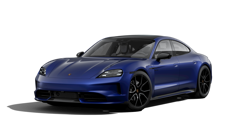
© 2022–2026 Mark Derrick. This article is original technical content.
TL;DR Summary
The 2026 Porsche Taycan typically charges from 10% to 80% in 20–25 minutes under favorable real-world conditions using a high-power DC fast charger. What matters in practice is not peak charging speed, but how consistently the Taycan sustains high power over time.
In North America, charging outcomes depend on both the available electrical infrastructure and the operating configuration of the vehicle’s charging system.
- Performance Battery Plus-equipped Taycans are among the fastest-charging EVs available, with peak DC charging power up to 320 kW.
- Charging behavior is determined by the curve, not peak kW; the Taycan sustains high power well into the session, slowing significantly above 80%.
- Home charging is slower than global specifications suggest; typically 8–9 kW (~9.6 kW max† with ideal residential circuit conditions).
- Public fast-charging performance depends on charger voltage and capability as well as network reliability, power sharing, and station conditions.
- The Taycan also supports compatible Tesla Superchargers via NACS adapter; they are generally reliable and well integrated, although their 400V architecture typically limits the Taycan to about 150 kW and older-site cable layouts can be awkward.
- Optimal strategy is to charge between 20%–80%, use AC charging for daily driving, and DC fast charging for road trips.
Key Takeaway:Real-world 10–80% charging time for the 2026 Porsche Taycan is typically 20–25 minutes under favorable conditions using a high-power DC fast charger.
Actual charging results vary with battery temperature, starting state of charge, charger capability, power sharing at the station, and network reliability—even two identical Taycans at the same charger can produce different results.
Bottom line: the Taycan delivers exceptional charging hardware, but real-world results depend on charging infrastructure, vehicle configuration, and operating conditions.
If You Own an Earlier J1.1 Taycan
This article focuses primarily on the current J1.2 Taycan introduced for model year 2025 and is intended mainly for prospective buyers and new owners. Many J1.1 Taycans remain on the road, and first-time owners of used cars may encounter different charging behavior.
Important differences can include earlier AC charging behavior and the WSS4 software update, optional rather than universal 150 kW charging capability at 400V DC stations on some earlier configurations, and a less aggressive DC fast-charging curve and narrower fast-charging temperature window than current J1.2 models. Where these differences materially affect the discussion, they are noted in the text.
Table of Contents
- The Taycan Battery & Management System
- Taycan Charging Overview
- Porsche Branded Chargers
- AC Charging the Taycan Battery
- DC Charging the Taycan Battery
- Battery Temperature and Charging Performance
- Finding Public Charging Stations For the Taycan
- Tesla EVSE Charging Compatibility with Taycan
- Establishing a Taycan Charging Session at a Public EVSE
- General Charging and Battery Care Instructions For the Taycan
- Understanding Taycan Charging "Timers and Profiles"
- Longer Road Trips in the Taycan
- Summary
The Taycan Battery & Management System
For the 2026 model year, the 105 kWh Performance Battery Plus is a very popular option in the Porsche Taycan range; in 2027 Porsche has announced the 105 kWh battery will be standard. As with most EVs, accessible capacity is intentionally limited. The Taycan battery management system (BMS) prevents full discharge or full charge, which could cause permanent damage. Porsche reserves part of the gross capacity for this purpose, leaving 97 kWh of accessible battery capacity.
The current Taycan battery and management electronics improve charging curve consistency, usable capacity, and thermal behavior1. In typical use, the updated system enables faster charging, increased range, and better cold-weather performance2. These improvements result from incremental refinements in battery design, thermal management, and power delivery rather than a single major change. For 2027, Porsche has also added a battery state-of-health display, allowing owners to view an assessment of the high-voltage battery’s condition.
The 800V architecture of the Taycan electrical system enables higher charging efficiency and sustained high-power DC charging, but at home in North America it AC charges at roughly the same speeds as most EVs. With a 100% State of Charge (SoC), the EPA range is up to 318 miles for rear-wheel-drive base trim models, with all-wheel-drive variants slightly lower depending on configuration. Independent third-party tests often exceed EPA estimates by 10% or more in favorable conditions, consistent with my experience.
Taycan Charging Overview
There are three common types of EV charging equipment in the US: AC Level 1 (120V AC), which can take days, AC Level 2 (240V AC), which can take hours, and DC Fast Charging (high-power up to 1000V DC), which can replenish a substantial portion of the battery in minutes. EV owners typically charge at home using AC Level 2 (L2) and rely on public DC fast charging (DCFC) networks for longer trips. Porsche recommends using AC Level 1 (L1) charging only in emergencies.
Three charging connectors are relevant to Taycan drivers in the US. The most widely used connector on non-Tesla vehicles in North America is the Combined Charging System Combo 1 (aka CCS1), which is used for DC Fast Charging and is also compatible with the SAE J1772 connector used for AC Level 2 charging at home and destinations. Tesla vehicles have the NACS connector that supports both AC Level 2 and DC Fast Charging.
| Charging Type | Connectors | Typical Voltage | Typical Power | Best Use Case |
|---|---|---|---|---|
| AC Level 1 (L1) | J1772 | 120V AC | < 2 kW | Emergency or very low-mileage charging |
| AC Level 2 (L2) | J1772 & NACS | 240V AC | 6–9 kW | Home charging and local destinations |
| DC Fast Charging (DCFC) | CCS1 & NACS | 400–800V DC | 150–320 kW | Rapid charging during long distance travel |
| For most owners, home L2 charging handles daily driving while public DCFC is primarily for road trips. | ||||
The 2026 and earlier Taycan can charge via a J1772 connection on the driver side or a CCS1 connection on the passenger side that also supports NACS via a recently available adapter3 in North America. The J1772 connection also supports charging via a third-party NACS adapter. The Taycan may be AC charged from either side of the vehicle while it may be DC charged only from the passenger side. The two charging ports are located just forward of the doors on each side, but the Taycan cannot charge from both simultaneously. (Starting with model year 2027, most North American Taycans replace the passenger-side CCS1 connection with a native NACS DC fast-charging port and include a CCS1 adapter. The Taycan Turbo GT with Weissach Package is an exception and does not receive the native NACS port.)
For North American 2026 Taycans, prior on-board charger configuration options have been eliminated or made standard. My 2026 Taycan Black Edition is equipped with the 105 kWh Performance Battery Plus, an 11 kW AC onboard charger, and maximum DC charging capability of 320 kW. That 11 kW figure describes the nominal onboard-charger hardware rating and should not be assumed to be the charging power a North American vehicle will draw from an AC EVSE or report at the battery. The 105 kWh battery capacity determines how much energy the Taycan can store, while the 320 kW maximum charging power determines how quickly it can be replenished. Some 2026 Taycans equipped with the smaller 89 kWh Performance Battery are rated for a lower 270 kW maximum DC charging power. For my Performance Battery Plus-equipped Gen 2 Taycan, the charging system is capable of accepting power at theoretical maximum charging speeds up to:
† Porsche global literature commonly describes the standard Taycan AC onboard charger as an 11 kW unit. In much of Europe that rating corresponds to approximately 400V three-phase service at 16A per phase. North American residential Level 2 charging normally supplies the vehicle with 240V single-phase power derived from split-phase service, so comparable power requires much higher current. Porsche’s North American documentation and current vehicle behavior indicate a nominal 9.6 kW AC ceiling on affected vehicles. Porsche’s 2026 WSS4 campaign reprograms the 11 kW onboard charger in J1.1 model-year 2020–2024 Taycans7 to reduce maximum North American Level 2 AC input to about 40A, corresponding to a nominal 9.6 kW at 240V. The J1.2 vehicles, including my 2026 Taycan, also appear to use this lower North American operating ceiling from delivery. Porsche’s terminology does not always clearly distinguish the OBC hardware rating from vehicle charging performance, and Porsche has not publicly explained the engineering rationale for the present ceiling.
- 1.9 kW from a 120-volt supply (AC via J1772 connection)
- 9.6 kW from a 240-volt supply (AC via J1772 connection) †
- 150 kW from a 400-volt supply (DC via CCS1 connection)
- 320 kW from a 800-volt supply (DC via CCS1 connection)
Porsche Branded Chargers
Porsche’s use of the term “charger” is a misnomer; these devices are more accurately called Electric Vehicle Supply Equipment (EVSE). The EVSE provides the interface to the electrical mains supply, advertises the AC current available to the vehicle, and provides the required control and safety interlocks. The Taycan’s onboard charging system determines how much current it will actually draw, subject to the EVSE limit, onboard-charger capability, vehicle configuration, software controls, and operating conditions. The power ultimately reported as battery charging is lower still because of onboard conversion losses and vehicle electrical loads.
The 2026 version of the Porsche Mobile Charger (PMC) EVSE accessory (PN:5914721C) comes standard with new Porsche North American EVs. Type 6/IP67 rated dust and water resistant, it includes an approximately 15 foot long cable and drawing a maximum of 40A is capable of charging the Taycan from a plug-in outlet. If a 240-volt outlet is not available, the equipment can be reconfigured to use a 120-volt outlet. The PMC includes a fabric storage bag to hold the EVSE and adapters. If the features of the PMC do not meet your needs, there are plenty of alternative third-party mobile and hardwired EVSE choices.
AC Charging the Taycan Battery
Most Taycan owners rely on AC Level 2 charging at home or destinations such as workplaces, hotels, and parking garages. In the United States, public L2 EVSE typically operate within a range of 7 kW to 11 kW. Many public L2 EVSEs deliver at the lower end of that range, sometimes below it. The J1772 standard technically supports higher-power AC charging up to 19.2 kW at 240V, though nearly all installations operate well below that level. This is related to EVSE current being limited to 80% of the circuit breaker rating for continuous loads.
For Level 2 charging at home with a plug-in EVSE, most Taycan owners install a dedicated 50A @ 240V circuit and NEMA 14-50 outlet. Porsche specifically recommends a Hubbell model HBL9450A receptacle located near where the vehicle is parked when being charged. Although, a J.D. Power study concluded that owners who installed a permanently hardwired L2 EVSE had the most satisfaction with home charging. A plug-in L2 EVSE drawing 40A delivers 8–9 kW and this corresponds to roughly 7–8 hours to charge from 20% to 80%. An hour of L2 charging will add 20 to 25 miles of range to your Taycan.
Why the Taycan’s AC charging numbers are easy to misread
Porsche literature, and many independent articles and individual discussions, do not always clearly distinguish between the Taycan’s onboard-charger hardware rating, the electrical specifications of EVSE, and the charging power actually reported by the vehicle. These figures describe different points in the charging system and are not interchangeable.
A 60A branch circuit, a 48A EVSE, an 11 kW onboard charger, and a Taycan reporting roughly 9 kW while charging can all exist at the same time without contradiction.
In much of Europe, an 11 kW onboard charger reaches its nominal rating from approximately 400V three-phase service at 16A per phase:
400V × 16A × √3 ≈ 11.1 kW
North American residential Level 2 charging normally supplies the vehicle with 240V single-phase power derived from split-phase service:
240V × 40A = 9.6 kW
240V × 48A = 11.5 kWAlthough a North American 60A branch circuit can support a 48A continuous EV load, that only establishes what the circuit and EVSE can make available. The Taycan determines how much current it actually draws. Porsche’s commonly stated 11 kW figure describes the nominal capability of the onboard-charger hardware; it does not by itself establish that a North American Taycan will draw 48A or report 11 kW while charging.
The kW value displayed by the Taycan is different again. It represents vehicle/battery-side charging power after onboard conversion losses and vehicle electrical loads. For this reason, the kW value shown by an EVSE and the kW value shown simultaneously by the Taycan can legitimately differ: the EVSE generally reports AC power supplied to the vehicle, while the Taycan reports power being delivered on the vehicle/battery side of the charging system. For example, if a 48A EVSE can make approximately 11.5 kW available but the Taycan draws only about 40A, AC input is approximately 9.6 kW and the vehicle may report roughly 9 kW reaching the battery.
Porsche’s own technical and marketing literature sometimes uses “11 kW” both for the onboard charger and as shorthand for AC charging capability, while North American documentation has also cited 9.6 kW. That terminology has understandably caused confusion.
My 2026 Taycan, using the same hardwired 48A EVSE that previously allowed my 2022 Taycan to report approximately 10.4 kW, consistently reports about 9 kW. This indicates that the 2026 vehicle is not using all of the AC current the installation can provide. Reports from other owners and Porsche’s WSS4 campaign show similar vehicle-side reductions in earlier cars, although Porsche has not publicly explained the engineering rationale for the present ceiling.
| Breaker Size | Continuous (80%) | Maximum EVSE AC Power at 240V | Typical Taycan-Reported Power |
|---|---|---|---|
| 30A | 24A | 7.2 kW | ~5.5–6.0 kW |
| 40A | 32A | 7.7 kW | ~7.0–7.5 kW |
| 50A | 40A | 9.6 kW | ~8.5–9.2 kW |
| 60A | 48A | 11.5 kW | ~8.5–9.2 kW* |
| 80A | 64A | 15.4 kW | ~8.5–9.2 kW* |
EVSE capability does not guarantee that the vehicle will draw the full available current; actual Taycan-reported charging power may be limited by vehicle configuration and operating conditions. * Current North American J1.2 Taycans appear limited to about 40A / 9.6 kW nominal AC input, so additional EVSE capacity above 40A does not increase normal AC charging power. Earlier J1.1 cars, especially before WSS4, may have used higher available current.
It might be best to consider ordinary household shared circuits with older receptacles to be a last-resort option for plugging in any 12A continuous load Level 1 EVSE due to the risk of overloading the circuit. Many residential garages are pre-wired with a dedicated 20A @ 120 VAC circuit for an electric clothes washer, and with their higher amperage rating this is a better choice. An L1 EVSE can take several days to fully trickle-charge a deeply discharged Taycan battery. An hour of L1 charging will add just 2 to 3 miles of range to your Taycan.
The following section highlights where Taycan charging behavior differs most from typical EVs.
DC Charging the Taycan Battery
The fastest possible EV charging is available from public facilities that use high-voltage DC charging equipment supplied by three-phase 480V AC utility service. DCFC stations are typically located near high-traffic commercial areas such as shopping malls, big box stores, and highway travel centers. Many modern highway chargers provide 150 kW or more with older chargers operating at 50 kW and new "hyper-fast" stations delivering 400+ kW, although the 2026 Taycan is limited to 320 kW.
Key idea: DC charging performance is governed by the charging curve, not peak power. Battery state of charge, temperature, and charger capability determine how much of that curve you use.
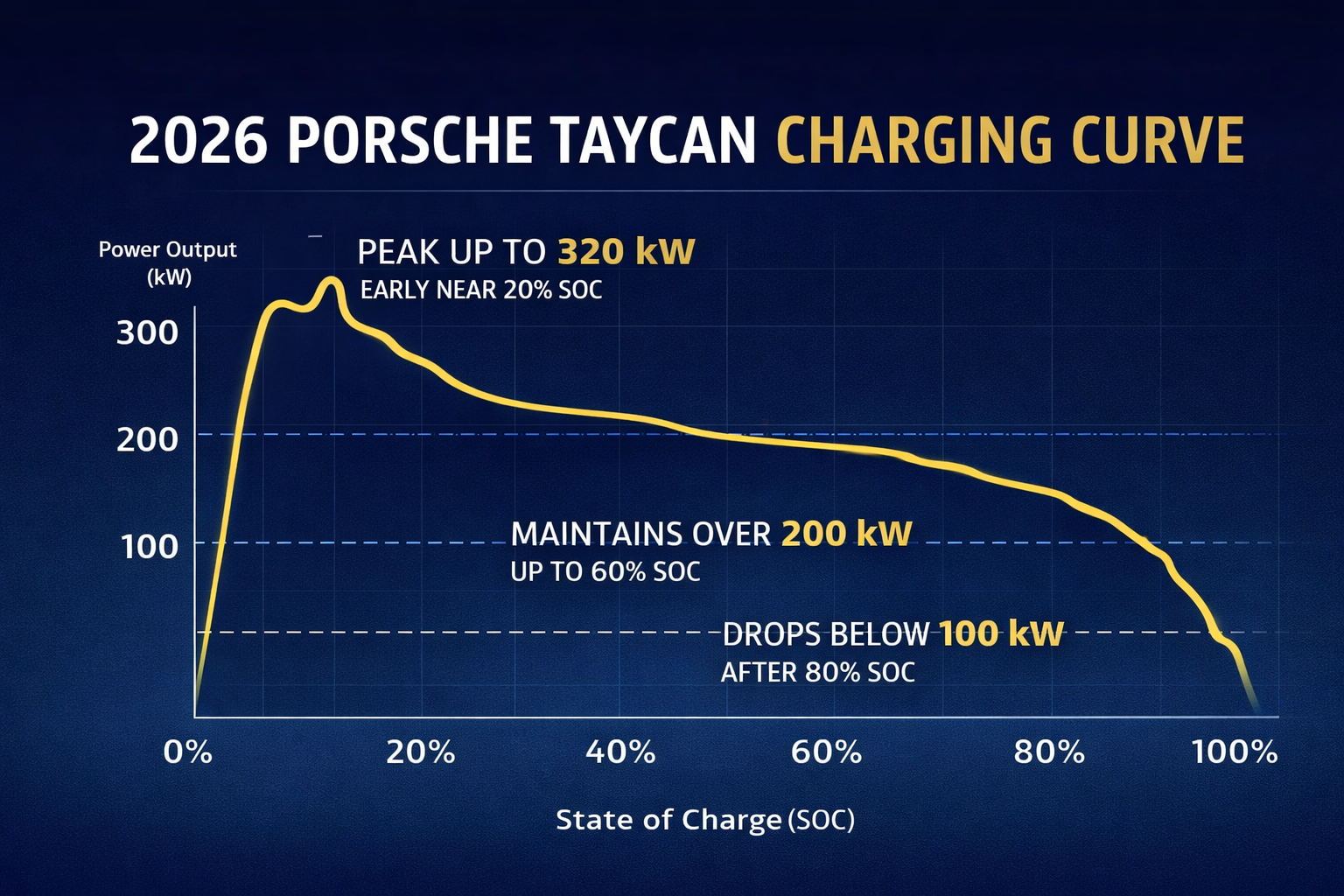
EV batteries cannot maintain maximum DC fast charging across the full cycle. Peak charging occurs at low-to-mid SoC, after which rising battery voltage forces the system to reduce current to maintain safe operating conditions. This behavior is reflected in the example charging curve4 shown in the graphic image above, but the actual curve is specific to each vehicle model and battery. Charging speed is determined by temperature, SoC, and EVSE capability.
Peak 320 kW charging is brief and occurs only under near-ideal conditions; in typical use, drivers often see peaks in the 250–300 kW range. What ultimately determines charging speed is sustained power, not peak capability. Higher peak kW does not necessarily translate to faster charging—vehicles that hold elevated power longer frequently outperform those with higher but short-lived peaks.
Under ideal conditions, the 2026 Taycan idealized charging curve can reach up to 320 kW below 20% SoC. It holds near 300 kW for several minutes, then tapers while maintaining over 200 kW through roughly 60% SoC, before declining more steeply and dropping below 100 kW beyond 80% SoC. What matters is how long the Taycan sustains high power. This is what enables its unusually fast 10–80% charging times. The charging curve can also be interpreted as range added over time. Under favorable conditions at low SoC, the Taycan can add roughly 50–70 miles of range in about five minutes of DC fast charging. As the charging curve tapers, the rate of range gain slows accordingly.
Most charging sessions fall within the commonly referenced 10–80% SoC range. Porsche marketing literature promotes that charging can take as little as 18 minutes under ideal conditions. Porsche specifies approximately 33 minutes from 10% to 80% when DC charging is limited to 150 kW8, so the difference is substantial rather than just a few minutes. Published figures typically measure only active charging time. In my experience, actual charging from 10% to 80% typically takes 20–25 minutes at a functioning 350+ kW charger under favorable real-world conditions, while the complete stop takes several minutes longer for parking, connecting, authentication, disconnecting, and returning to the road.
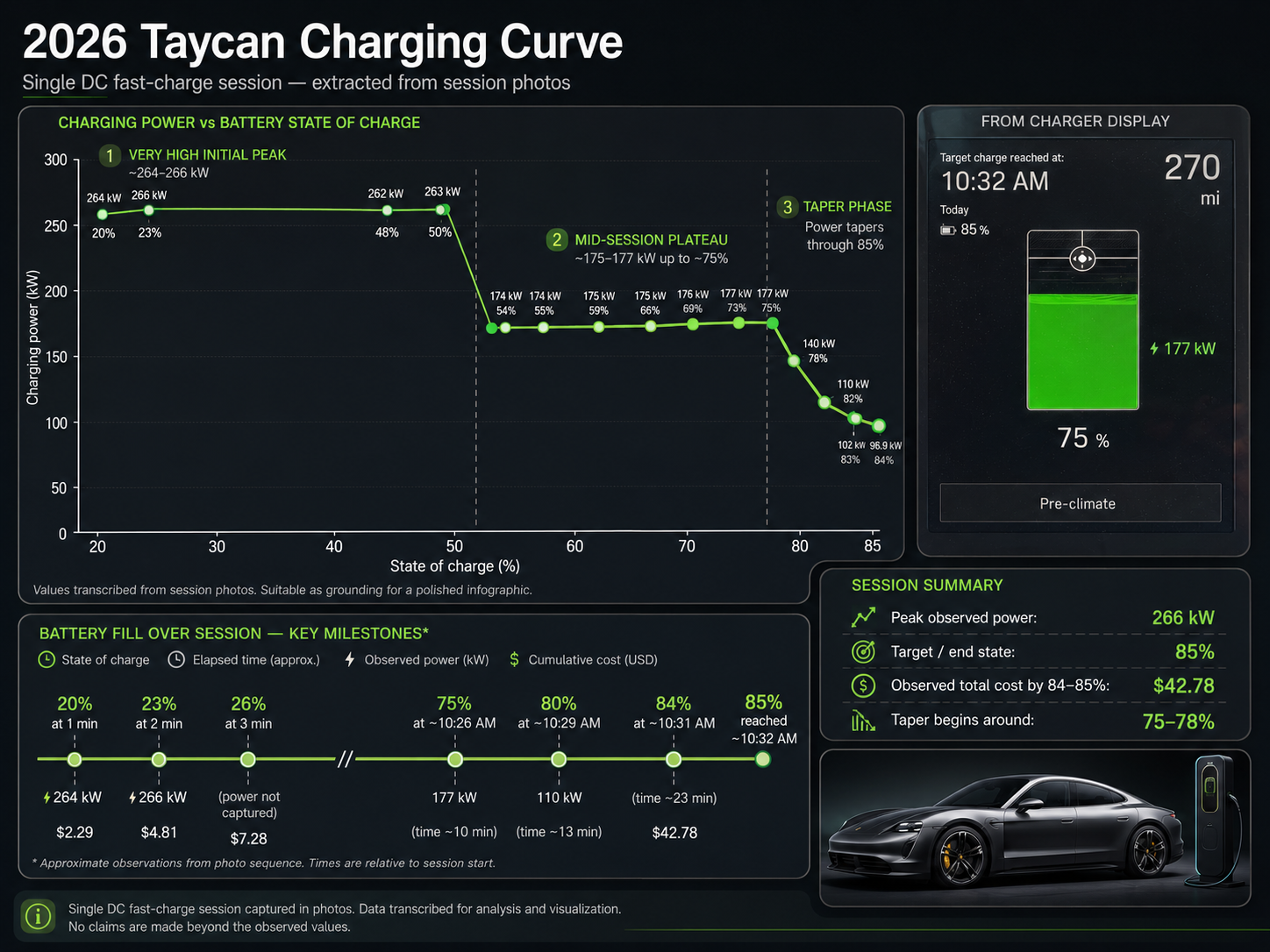
Below is the actual charging curve from my 2026 Taycan during a May 2026 DC fast-charging session. The car started at 14% SoC and reached 85% in 24 minutes at a popular Electrify America station located at a Target in Deerfield Beach, Florida. On this visit there was no wait for an available 350+ kW balanced EVSE. Including the time to pull in, connect, authenticate through Plug & Charge, charge, disconnect, and drive away, the total stop was about 30 minutes. This has been my typical real-world Taycan charging experience, plus any additional time that may be required if all EVSE are occupied on arrival.
Some conscientious owners also choose to limit peak charging power by preferring 150 kW EVSEs in certain situations to reduce thermal load and fan activity, particularly during repeated fast-charging sessions or hot ambient conditions. The tradeoff is meaningful on the current Taycan: Porsche specifies approximately 33 minutes for 10–80% charging when limited to 150 kW, versus approximately 18 minutes under ideal conditions at a suitable 800V high-power charger8. At busier stations with a mix of fast and hyper-fast EVSEs, however, using an available 150 kW unit may still be faster overall than waiting for a higher-power unit. EVSEs also do not always deliver their rated maximum power; station thermal limits, shared infrastructure, or equipment condition can result in lower-than-expected charging speeds even when a high-power charger is selected.
In some cases, two or more adjacent EVSEs may be configured to cooperate and share a single electrical supply. Power sharing allows multiple EVSEs to distribute available capacity across active units. Another term for this arrangement is 'balanced', and it works in practice because power demand from multiple vehicles varies greatly through the charging cycle, making it unlikely multiple vehicles will demand peak power simultaneously. Few public charging stations identify which if any of their EVSEs are balanced, but that can explain why at a busy station your Taycan is not charging at the speed you expect.
Congestion at DCFC stations refers to drivers having to wait to charge their vehicle because all the EVSEs are in use. Many drivers are unaware that charging from 80% to 100% can nearly double charging time and significantly contribute to station congestion. Some public charging stations are now limiting the maximum SoC to 80% or 85% to reduce congestion.
Ultimately, network reliability and charger availability matter more than the difference between 150 kW and 350+ kW capability.
Battery Temperature and Charging Performance
EVSE capability and SoC are important, but battery temperature still affects the charging power available at any particular moment. The current Taycan has a substantially wider fast-charging temperature window than the previous generation. Porsche reports that the updated Taycan can charge from 10% to 80% in 18 minutes with a starting battery temperature of 59°F (15°C), compared with 37 minutes for the previous generation under the same conditions9. I’ve also seen the opposite extreme firsthand during very hot weather, where charging slowed significantly and in some cases stopped due to over-temperature warnings. The battery management system (BMS) adjusts charging power as necessary to keep the battery within safe operating conditions.
Ambient temperature matters mainly through its effect on battery temperature and the amount of heating or cooling the system must provide. In real-world conditions, battery temperature is also strongly influenced by recent driving and charging history. The wider current-generation charging window means that a relatively cool battery does not necessarily prevent very fast charging, but extreme temperatures can still reduce available power.
The Taycan has a heat pump that the BMS can use to adjust the temperature of the high-voltage battery as it deems appropriate, called preconditioning. When navigating to a DC fast charger with the PCM Charging Planner, the vehicle preconditions the battery toward the optimal range, improving charging performance. For the BMS to optimize the battery temperature for charging, the PCM navigation system destination should be set by selecting a specific charging station using the PCM Charging Planner and not simply entering the street address of a charging station. Even in warm climates, the battery may not be at optimal temperature after short drives or extended parking. Conversely, during extended highway driving or repeated fast-charging sessions, the battery can become heat-soaked, reducing charging performance despite favorable ambient conditions.
Preconditioning still requires some time and distance to be effective; the BMS cannot instantly change battery temperature when a charger is selected. As a practical rule of thumb, selecting the DC fast charger in the PCM Charging Planner well before arrival gives the system time to prepare the battery, although the current generation’s wider fast-charging temperature window makes the exact distance or time less critical than on earlier Taycans. Short trips or last-minute navigation changes may still provide too little time for useful preconditioning, something I’ve personally experienced when making unplanned DCFC stops because I was not disciplined about AC charging at home.
Finding Public Charging Stations For the Taycan
The "Porsche Charging Service" free subscription allows the driver to use the Taycan PCM to locate and navigate to many nearby public charging stations. The "My Porsche" app can also locate and navigate to preferred charging stations as well as manage and pay for charging at Electrify America and Charge Point stations. All the major EVSE networks have branded smartphone apps that are best at finding their own network charging stations as well as reporting their real-time status and availability. Drivers should also install a brand-agnostic charging app; it is essential for finding and navigating to virtually all public charging stations, including many non-networked ones. One of the most popular is PlugShare, offering a rich amount of crowdsourced information about the stations and nearby amenities.
Public charging prices vary widely—sometimes even by time of day—depending on the network, location, EVSE power level, and whether you are paying a higher guest rate or a discounted member rate. ChargePoint is a large network of privately owned charging stations where individual site hosts set their own pricing, and in my experience some locations can be surprisingly expensive. Although residential electricity in Florida averages less than 15 cents per kWh, DC fast charging typically costs between 45 and 60 cents per kWh without a subscription. This translates to roughly 5–6 cents per mile when charging at home, compared to up to about 25 cents per mile for DC fast charging. That means a typical 10–80% DC fast charging session could cost $30 to $40 at non-member rates. Check prices when multiple charging stations or EVSEs are available.
Tesla EVSE Charging Compatibility with Taycan
Tesla is widely regarded as having one of the most reliable DC fast-charging networks. All North American Tesla vehicles since 2012 use the same unique Tesla developed NACS connector. Originally proprietary and now standardized as SAE J3400, the 2026 and earlier Taycan cannot charge directly via the connector - an adapter is required. Porsche’s NACS to CCS1 DC adapter (manufactured by Lectron), introduced in 2025, is standard with 2026 Taycans. Compatible Tesla Superchargers are now integrated into the Taycan charging ecosystem: J1.2 vehicles can route to supported locations through PCM, precondition the battery for the stop, and use Plug & Charge when properly configured, although occasional authentication failures can still require using the Porsche or Tesla app to initiate a session. The 2027 Taycans, except the Taycan Turbo GT with Weissach Package, will instead have a native passenger-side NACS DC fast-charging port and therefore will not require an adapter at compatible NACS DC stations. Porsche will supply a CCS1 adapter for using CCS-equipped DC fast chargers.
Tesla’s Supercharger network is primarily a 400V architecture, so a current Taycan will generally be limited to roughly 150 kW at compatible V3/V4 Superchargers even though the vehicle can accept substantially more power from suitable 800V DC fast chargers. In practical terms, this can increase a 10–80% charging session from roughly 18 minutes on a suitable high-power 800V charger to about 33 minutes when charging is limited to around 150 kW. In real-world use, the more persistent limitation is often physical rather than electrical. Parking layouts and cable lengths at many older Supercharger sites were optimized for Tesla vehicles, which have the charging port on the driver-side rear corner. With the Taycan, the relatively short cable can require parking unusually close to the EVSE or using a neighboring stall position, sometimes interfering with an adjacent charging space. Newer V4 and pull-through installations generally improve cable reach. Compatibility still depends on Supercharger hardware and site enablement, so it is best to confirm the specific location before arrival.
Tesla also has a public network of AC Level 2 destination stations at popular hotels, restaurants and resorts. The NACS to CCS1 adapter accessory included with the 2026 Taycan can NOT be used with AC Level 2, as it is unable to pass the required AC signal to the CCS1 port. However, any Tesla or other brand NACS compatible AC Level 2 EVSE can charge the Taycan using a third-party adapter such as the Lectron Tesla to J1772 EV adapter. If you use AC Level 2 charging away from home, purchasing this additional adapter will increase your available options. Warning: Although mechanically compatible with Tesla Superchargers, the 3rd party NACS to J1772 adapters must ONLY be used with AC Level 2 EVSE.
Establishing a Taycan Charging Session at a Public EVSE
A 2025 study indicates that roughly 14% of charging attempts result in a "non-charge visit"5, but this average includes the significantly more reliable Tesla network. My personal experience at non-Tesla stations is consistently worse than the study average. On a recent long distance round trip along the Florida Turnpike there were issues with five of six DCFC charging attempts. Authentication issues necessitated simply moving to an adjacent EVSE in three cases (FPL, EA and EV-Connect); one EVSE had something physically wrong with the plug and would not fully plug-in (EA) that again necessitated moving to an adjacent EVSE; and in one case all the EVSEs at the entire station were out-of-service (FPL) even though their app did not indicate an outage that required continuing to a later (EA) station further along the route.
To start a charging session, select a working EVSE, park within cable reach, and plug in. Authenticate the EV charging session for those that require billing, typically using a mobile app or swiping/tapping a payment card. Once authenticated, the charging session begins. Once the charging session automatically completes or is manually ended, after a brief grace period most DCFC stations will begin billing for 'idle' time if the cable remains connected so always move the vehicle out of the charging stall as soon as possible after charging.
Charging at a public EVSE works slightly differently with each of the apps and with each of the charging station networks, plus the exact sequence of steps are not always intuitive. Figuring out the differences when under time pressure as they are encountered can make for frustrating early experiences with public charging. "Plug & Charge" is a seamless process that allows a vehicle to automatically initiate a charge once it is simply plugged into a Plug & Charge enabled EVSE.
Currently, Porsche supports Plug & Charge at Porsche Center Turbo Chargers, Electrify America (EA), and Tesla Supercharger stations. Porsche Charging Service subscription must previously have been activated and a credit card stored at the My Porsche website. Plug & Charge must also be enabled in PCM settings on the Taycan. If everything is configured, then just drive up and plug in without further authentication. It can take up to 60 seconds to establish the session; be patient and do not interrupt the process. In my experience, occasionally a specific EA EVSE will fail to authenticate with Plug & Charge and the session has to be started using the My Porsche app or move to an adjacent EVSE.
FYI, Porsche’s WSQ7 campaign documents that nonstandard current peaks from some public DC chargers can trigger protective action by the Taycan’s high-voltage voltage converter. The published campaign describes a permanent loss of DC fast-charging capability on certain model-year 2025 vehicles. I experienced a similar but different event in my 2026 Taycan. A charging disturbance occurred when the driver of a old Chevrolet Volt using the adjacent EVSE unplugged her vehicle while it was apparently still charging. My Taycan then became inoperative and displayed a yellow “Electrical system error: Service required” warning. It recovered after I locked the vehicle and left it undisturbed long enough to complete a full control-system shutdown, commonly called the “lock and leave” maneuver. It is not presently clear whether the two events share the same technical cause, and Porsche has not published an equivalent campaign for model-year 2026 vehicles.
General Charging and Battery Care Instructions For the Taycan
As EV batteries accumulate charge cycles, maximum energy storage gradually declines and maximum driving range is permanently reduced. While the battery SoC can theoretically range from 100% to 0%, general studies have shown that consistently operating an EV with a battery SoC significantly low or high will also more rapidly reduce the EV maximum driving range.
High-power DC charging can increase battery wear, but modern battery management systems appear to limit much of that effect. The long-term impact appears modest, even when DC fast charging is the primary charging method. For daily use, that implies there is value in avoiding ultra-fast charging when practical. For conscientious owners, Taycan range declines by about 2% per year on average, although actual degradation varies with usage, temperature exposure, and charging patterns.6 Degradation is not linear. There is typically a larger drop during the first 3 to 18 months, after which the rate of decline slows significantly. Current projections suggest a total decline of roughly 10% to 15% over eight to ten years, which is a reasonable expectation for long-term battery performance.
The BMS will warn when the SoC declines to 15% and below. You may hear or read conflicting advice from various sources regarding recommended limits for State-of-Charge, but quoting from 2026 Taycan Owner’s Manual – "For daily use of the vehicle without long-distance journeys, set the battery charge to approximately 90%." and "Charge the high-voltage battery if the battery charge is under 5%." The ambient temperature, as indicated by the value displayed on the left-hand side of the driver’s instrument cluster, can be a factor to consider in deciding when, how and how much to charge. The manual has a long list of recommendations that can make the topic seem overwhelmingly complex. For most use cases, charging from 20% to 80% SoC provides the best balance of speed and efficiency; here is my simplified guideline for conscientious owners of any model year Taycan:
Charge when the battery SoC falls below 20% and configure PCM battery settings to automatically end charging sessions when the battery SoC reaches 80%. Avoid charging to 100% except for extended trips where the vehicle will be driven below 80% shortly after charging. Unnecessarily ‘topping off’ the battery SoC, or consistently maintaining the battery SoC above 80% or below 20% for long periods, may permanently reduce the driving range.
Porsche also has specific additional recommendations for charge management during long idle periods of storage. In particular, failure to maintain the auxiliary 12V "starter battery" will deactivate the entire Taycan electrical system and prevent the car from operating. This seems to have been more of an issue in earlier Taycans, but during purchase of my 2026 Taycan the dealer required me to sign a document acknowledging I had been advised damage from failure to maintain the auxiliary battery charge is not covered under warranty and can be expensive to repair.
Understanding Taycan Charging "Timers and Profiles"
Depending on your circumstances and the billing plan you have established with your power company, home charging during off peak hours may offer a significant cost savings. For example, our power company in South Florida offers a plan that includes unlimited charging during nights and weekends at no additional cost. Taycan profile and timer settings can be used to establish default and/or location based charging SoC targets for charging sessions and then the Taycan will automatically start and stop the charging based on those parameters. Many wi-fi connected AC Level 2 devices can also manage this, but my experiences with third-party 'intelligent' EVSE suggests it might be better to avoid using their timers and allow the Taycan to natively manage its own charging.
A Profile has a "Minimum SoC" setting value (I suggest 20%) which can override the "Preferred Charging Hours" settings when the Taycan is plugged in to an L2 EVSE. If the Taycan battery actual SoC is below the minimum SoC setting in the profile, then charging will begin immediately regardless of the preferred charging hours and charge until minimum SoC is reached and then cease. When the actual battery SoC is above the minimum SoC, then charging begins (or resumes) during the preferred charging hours. Set up a charging daily timer with a departure time when you want charging to be completed and the Taycan won’t start until necessary and stops when the "Target" SoC is reached.
Longer Road Trips in the Taycan
The Taycan PCM trip planner is suitable for short trips to the next charger, but for longer trips with multiple charging stops many drivers use A Better Route Planner. There is no perfect solution and experienced EV drivers typically use a combination of tools for planning. (For 2027, Porsche has announced an improved PCM that includes an optimized Charging Planner, faster processing, and revised navigation, although further details remain limited.) PlugShare is better at finding hotels with charging facilities and rates the quality of many charging stations. ABRP is better at optimizing the quantity, length and location of charging stops for longer trips; particularly when preferring specific charging network brands. Branded charging network apps are better at providing near real-time status of their own EVSEs at the charging stations.
For longer trips, improve charging efficiency by navigating to DC fast charging stations using the PCM Charging Planner. Plan stops with backup options and avoid arriving with very low remaining range. Maintaining a buffer of roughly 25 to 50 miles provides a hedge against unforeseen circumstances, particularly in areas with limited infrastructure. Because charging power is highest at lower SoC, multiple shorter sessions that begin at lower battery levels are often more time-efficient than fewer longer sessions that extend well beyond 80% SoC.
For highway road trips, driving in segments of approximately 125 to 175 miles between charging stops is generally time-efficient and works well in practice. Some congested public stations limit maximum SoC, and real-world stops are rarely as time-efficient as theoretical charging times suggest. For planning, expect stops to take a few minutes longer than the charging session. Combining charging stops with meals or breaks at nearby locations can make more efficient use of time.
For overnight stays, it is best to find lodging that offers AC Level 2 facilities for use while you sleep. Prudent drivers will try to plan to arrive at the destination for overnight charging while the remaining SoC provides enough range to reach a DCFC station. That’s because many destinations will have a limited number of EVSEs and, especially by late evening, there may not be any available thus requiring a DCFC shortly after departure the next day. On road trips I pack my PMC bag along with NACS to CCS1 and J1772 adapters, three and four prong 30A to 50A RV adapters, and even the 120VAC pigtail for the PMC. The extra weight is worth the peace-of-mind about concerns being at an unfamiliar destination and unable to charge.
Typically, small variances such as traffic delays or conversely making better time than expected, getting a different amount of charge than planned, and many other factors such as weather and who is driving will ripple through a tight multi-day travel plan with substantial effect. With each successive charging session, the planned future charging stations can change and that will often affect the choice of lodging. The key takeaway for long distance travel with the Taycan is to be flexible!
Summary
The Taycan’s charging performance is best understood by looking beyond peak specifications. The 2026 Taycan remains one of the fastest DC charging EVs available—not because of peak numbers, but because of how efficiently it manages power across the charging curve.
- The 2026 Porsche Taycan charges from 10% to 80% in typically 20–25 minutes under favorable real-world conditions using high-power DC fast charging.
- Peak charging power of up to 320 kW occurs only briefly; sustained charging power is more important for overall charging speed.
- In real-world use, most of a charging session occurs below 200 kW before slowing significantly above 80% as part of the normal charging curve.
- Charging performance depends on battery temperature, starting state of charge, charger capability, and station conditions.
- In practice, charging infrastructure reliability and availability have a greater impact on total charging time than vehicle capability.
If you’ve read this far, you now understand how the Taycan charges in real-world conditions—not just manufacturer specifications. Understanding the charging curve—not the peak number—is what actually determines real-world charging performance.
Acronyms & Definitions
- BMS — Battery Management System
- CCS1 — Combined Charging System Combo 1
- DCFC — DC Fast Charging
- EVSE — Electric Vehicle Supply Equipment
- J1772 — Standard AC charging connector
- NACS — North American Charging Standard
- OBC — On-Board Charger
- PCM — Porsche Communication Management
- SoC — State of Charge
Sources & References
- Porsche Newsroom – E-Performance: cell research for future batteries
- Porsche Newsroom – Taycan thermal management and cold weather performance
- Porsche Newsroom – Porsche owners can now access the Tesla Supercharger network
- EVKX – Porsche Taycan charging curve data
- J.D. Power – 2025 U.S. Electric Vehicle Experience (EVX) Public Charging Study
- Recharged – Porsche Taycan battery degradation analysis
- Porsche WSS4 Technical Information – OTA reprogramming of the 11 kW onboard charger
- Ask Porsche – Taycan charging speed on 800V and 400V DC infrastructure
- Porsche Newsroom – Updated Taycan charging performance at lower battery temperatures