Sofnolime CO₂ Absorbent for Rebreathers
Sofnolime® is the Molecular Products brand name for soda lime formulations of carbon dioxide absorbent. In diving, it is used to remove carbon dioxide from recirculated breathing gas in closed-circuit and semi-closed rebreather systems. This page is background information for rebreather divers.
Terminology: Granule Size, Indicator, and Grade
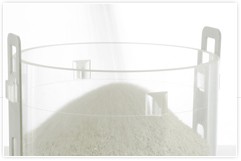
Rebreather divers and purchasing agents new to carbon dioxide absorbent can be tripped up by the terminology. The absorbent-versus-adsorbent debate does not add much in normal diving discussion; most experienced rebreather divers simply call the material sorb. The important terms are granule size, indicator, and grade.
Granule size. Absorbent is a mixture of different-sized granules. Modern specifications describe particle size in millimeters and distribution by percentage. The common granular mixture for modern diving rebreathers is 8-12 mesh, or 812. This means most particles fall in the range associated with #8 to #12 woven-wire mesh openings, roughly 2.0 mm to 1.4 mm, with nearly all particles in the broader 2.5 mm to 1.0 mm range.
Another size used in some commercial diving and older equipment is 4-8 mesh, or 408. This larger granule range is associated with #4 to #8 mesh openings. No size or shape is automatically better; granule size, pressure drop, absorption capacity, packing behavior, scrubber design, and work-of-breathing requirements are application-specific trade-offs.
Indicator. Some absorbents include dyes that temporarily change color as carbon dioxide absorption reactions occur. White-to-violet is abbreviated WV, pink-to-white is PW, and non-indicating is NI. Manufacturers state that their indicator dyes do not adversely affect performance, but some purchasing requirements prohibit indicator dye. In rebreather use, indicator color is not a reliable way to evaluate scrubber-stack usage or justify reuse.
Grade. Grade identifies the formulation and documentation package: ingredients, binders, moisture content, particle size, particle shape, and the intended testing or purchasing standard. Grades exist for anesthesia, mine safety, submarine air purification, commercial diving, rebreather diving, and other applications. Similar formulations may carry different grade names when one version is documented or tested for a specific requirement. Using the wrong absorbent, especially substituting an anesthesia or medical grade for a diving grade, can have deadly consequences.
Sofnolime is the Molecular Products brand name for soda lime carbon dioxide absorbent formulations. Grade CD is associated with the larger 4-8 mesh size and is used in commercial diving and hyperbaric chamber systems. Some early rebreather designs specified 408 absorbent, but that is uncommon in modern sport and technical rebreather use. Grade 797 is the Sofnolime grade commonly specified for modern rebreathers and is referred to by divers as 812. The Molecular Products description for the common 1.0 mm to 2.5 mm non-indicating diving formulation is Sofnolime™ 8-12 Mesh NI (Grade 797).
Be careful with product descriptions. Mixed-up terms such as “Sofnolime 797, Grade 408WV” or “812 CO2 adsorbent, Grade CD” are internally inconsistent. That kind of description often refers to a larger 4-8 mesh indicating formulation intended for commercial diving applications. Mesh size alone is not adequate identification because similar particle sizes are used in non-diving formulations. If the description does not clearly state non-indicating, or NI, the product may be indicating absorbent.
Characteristics of Sofnolime
Soda lime carbon dioxide absorbents are hard, off-white granular materials with little odor. The main differences between grades are particle size, particle shape, moisture content, hardness, and the testing regime used for the intended application.
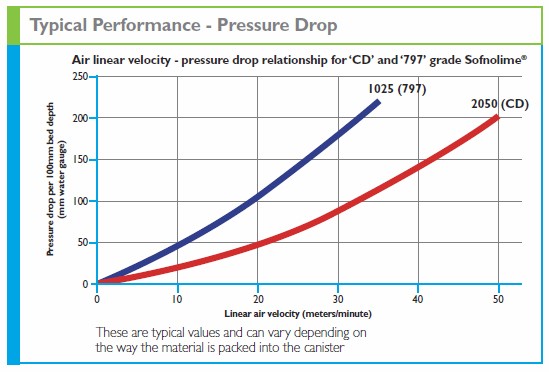
Particle size affects reaction speed, reaction-zone volume, and bed duration. Smaller particles react faster and can make the reaction zone smaller, but they also increase pressure drop across the absorbent bed. In a breathing loop, pressure drop can become a work-of-breathing issue.
Sofnolime particles are shaped to increase surface area and promote contact between breathing gas and absorbent. Larger CD-grade particles use a D-shaped or semicircular cross-section. Smaller 797-grade particles use a triangular cross-section. These shapes reduce the distance to the center of the particle and help avoid straight-through gas channels in the absorbent bed.
Soda lime absorbents require moisture to function properly. The moisture content is part of the formulation, not contamination. Drying it out, baking it, freezing it, or treating the keg like ordinary dry granules defeats the way the material is intended to work.
Sofnolime is formulated to resist granule breakdown and dust generation. In rebreather applications, low dust levels are desirable because dust can increase pressure drop and can contribute to caustic contamination if absorbent dust contacts moisture in the breathing loop.
For diving, many specifications and common practice favor non-indicating absorbent. Indicator dye should never be treated as permission to reuse absorbent or extend scrubber duration beyond the equipment manufacturer’s instructions.
Chemistry of CO₂ Absorption
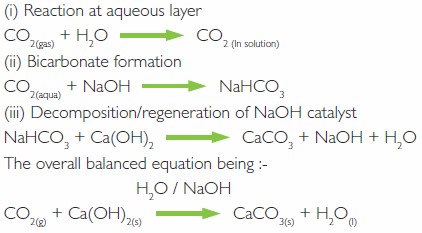
Carbon dioxide is removed by a water-mediated, base-catalyzed, exothermic chemical reaction. The simplified result is that calcium hydroxide is converted to calcium carbonate, with heat and water produced during the reaction. Sodium hydroxide acts mainly as a catalyst.
The heat and water produced explains why a rebreather loop often feels warmer and less drying than open-circuit scuba. Those effects are secondary to CO₂ removal, but they are real practical benefits of recirculating gas through an active scrubber bed.
Mechanics of CO₂ Absorption
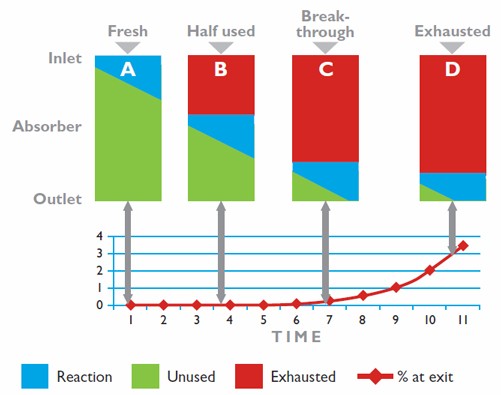
A scrubber holds a bed of absorbent. Breathing gas passes through that bed, and the reaction occurs first where the gas enters the absorbent. As absorbent near the inlet is consumed, the active reaction zone moves progressively through the bed.
The reaction zone is not a perfectly flat line. It is uneven because gas flow, packing density, temperature, moisture distribution, and scrubber design are not perfectly uniform. This is why correct packing technique and manufacturer-specific scrubber loading instructions matter.
While active absorbent remains, the scrubber removes essentially all carbon dioxide entering the bed. When the leading edge of the reaction zone reaches the outlet end, carbon dioxide begins to appear in the exiting gas. This is breakthrough. Once the main reaction zone reaches the end of the bed, exiting carbon dioxide can rise rapidly.
Scrubber duration is finite. It depends on the absorbent quantity, absorbent grade, scrubber design, packing quality, temperature, breathing rate, work rate, and the amount of carbon dioxide produced by the diver. Published scrubber durations should be treated as equipment-specific limits, not generic absorbent limits.
Applications for Sofnolime
Diving is a demanding carbon dioxide removal environment because scrubbers operate across wide temperatures and at elevated pressure, where increased gas density affects work of breathing and gas movement through the absorbent bed.
For diving applications, the main practical distinction between Sofnolime 797 and CD is the trade-off between absorption capacity and pressure drop. Molecular Products describes 797 as having higher carbon dioxide absorption capacity than CD, while CD may be used where lower pressure drop is desirable.
Military grades are used in submarines and combat rebreather systems and may be tested against NATO STANAG requirements. Medical grades are designed for anesthesia systems and have different performance priorities. Do not substitute medical-grade absorbent in a diving rebreather. It is the wrong material for the application.
For product-specific details, use current Molecular Products documents rather than old forum posts, dealer descriptions, or copied catalog text. Useful references include molecularproducts.com/resources, Performance Testing of Sofnolime 797 and Other Diving Grade Soda Lime Samples at Depth, and Use of Medical Grade Sofnolime in Diving Applications.
Transport & Storage of Sofnolime
Sofnolime is treated as non-hazardous for transport by road, rail, sea, and air under the manufacturer’s transport documentation. The confusion usually comes from the fact that the material is alkaline and carries handling warnings. For transport questions, the relevant documents are the Sofnolime Safety Data Sheet (SDS) and the manufacturer’s Sofnolime non-hazardous transport letter.
When correctly stored, intact and unopened plastic containers of Sofnolime can maintain absorption capacity for five years. The container should remain tightly closed and stored within the manufacturer’s specified range of 32–95°F (0–35°C). Excessive heat, direct strong sunlight, and freezing conditions are storage problems because they can mechanically and chemically damage the absorbent. Containers should not be exposed to partial or total water immersion, abnormal concentrations of carbon dioxide, or excessive stacking loads.
Handling & Usage of Sofnolime
Sofnolime is alkaline. Avoid prolonged skin contact and all contact with eyes or mucous membranes. During filling and emptying, use suitable eye, face, and hand protection, and use a nuisance dust mask when working with granules. Wash after handling, avoid breathing dust, and do not eat, drink, or smoke while handling the product. Follow the current Safety Data Sheet if exposure occurs.
Follow the absorbent packing and scrubber-duration instructions for the specific rebreather model being used. The wrong product, poor packing technique, disturbed absorbent, channeling, or extended use can create excessive work of breathing, shortened scrubber duration, or inadequate carbon dioxide removal. Scrubber loading is critical to performance. Follow the equipment manufacturer’s loading and operating instructions precisely. Never disturb and reuse a partially expended absorbent bed; mixing used and unused material can impair the bed and create an unpredictable reaction zone. A video of a real rebreather emergency associated with improper absorbent handling is available at youtube.com/watch?v=vtdfSVwHCNI.
If indicating absorbent is used and left to stand, the dye can slowly return toward its original color as unreacted sodium hydroxide migrates to the surface of the granules. This is not regeneration. Absorbent in this condition must never be reused; its remaining capacity can be exhausted quickly. If dye indication is part of the procedure, empty or change the absorbent bed immediately after use.
Disposal of Sofnolime
Empty Sofnolime kegs are high-density polyethylene containers and are recyclable when emptied and cleaned. Used absorbent granules from rebreather diving applications are often handled as ordinary trash. Do not dump used absorbent overboard in marine environments; shipboard trash and plastics are subject to disposal restrictions. The major reaction product in used soda lime absorbent is calcium carbonate, a naturally occurring mineral. That does not make every bucket of used sorb harmless or universally disposable. Unexpended calcium hydroxide, residual alkalinity, and sodium hydroxide can affect disposal classification. When disposal rules matter, follow local regulations and the current Safety Data Sheet.
Summary
Sofnolime is not generic absorbent. For rebreather use, the important details are the correct diving grade selection and exact scrubber packing according to the rebreather manufacturer’s instructions. The practical rules are simple: use the absorbent grade specified for the unit, keep it sealed and properly stored until use, do not disturb and reuse a partially expended scrubber bed, do not rely on indicator color as a scrubber-life gauge.