Mark and the DIBOL Years
A personal history of DIBOL, DECUS, standards work, and teaching the language.
Before technical diving and e-commerce became the most visible parts of my working life, there was DIBOL—a business programming language that occupied much of my professional attention and introduced me to an unusually capable community of programmers.
This is not intended to be a complete history of DIBOL. It is the part of that history I happened to live.

DIBOL was a practical language for practical work. Its importance is difficult to measure by present-day visibility because much of its success lived inside systems that simply kept businesses running.
An Unexpected Second Career
My professional identity eventually became associated with technical diving, but long before that I was an information-technology professional and an expert DIBOL programmer. DIBOL was not merely a language I encountered occasionally. I worked with it deeply enough to teach it, participate in its user community, and help with the formal standards process that defined the language.
That work belonged to an era when programmers were often much closer to the businesses they supported. A program was not an abstract exercise. It handled advertising, billing, inventory, scheduling, accounting, or another operation that had to be correct every day. The best programmers learned both the language and the business.
DIBOL as a Working Language
DIBOL—Digital's Business Oriented Language—was designed for commercial data processing. Its record-oriented approach and straightforward syntax made it especially well suited to the kind of applications that moved information through real organizations. It was commonly found on Digital Equipment Corporation systems and evolved along with them.
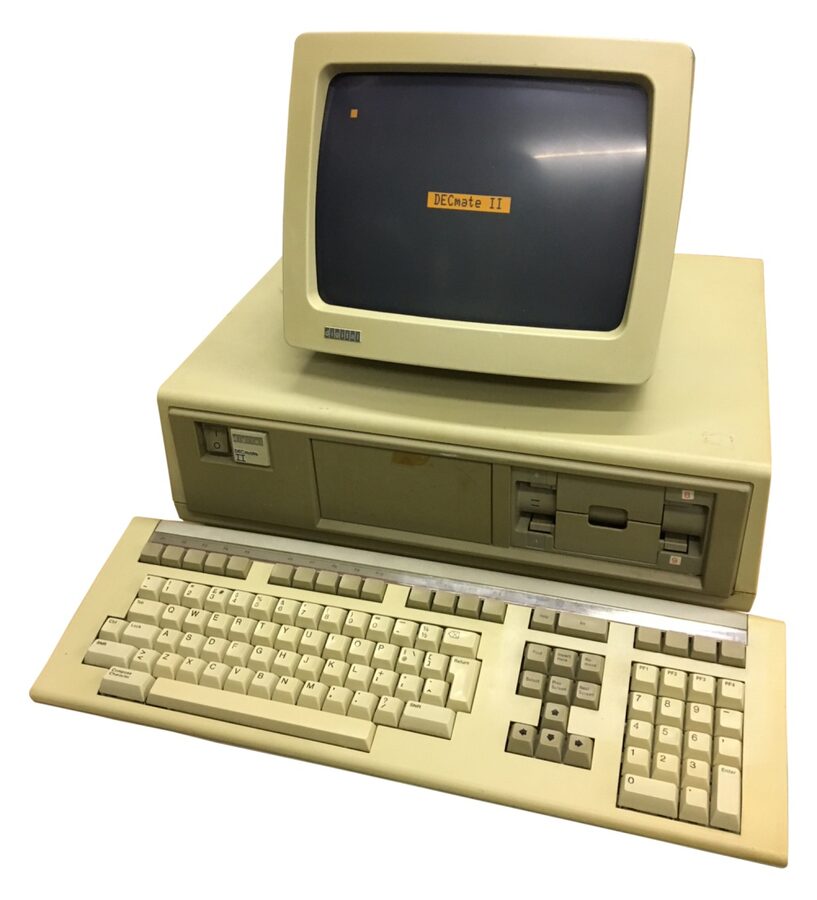
The language never acquired the cultural visibility of COBOL, BASIC, or C, but visibility is not the same thing as usefulness. DIBOL applications performed substantial work, often for many years. A well-written business system could remain valuable long after the computer on which it was first developed had been replaced.
Writing that kind of software demanded more than knowing statements and syntax. It required disciplined file design, careful treatment of numeric data, predictable error handling, and an appreciation for maintainability. Business software tends to expose every casual assumption eventually.
The DECUS Community
The principal community around Digital systems was DECUS, the Digital Equipment Computer Users Society. DECUS was much more than a conference organizer. It provided a way for working programmers, system managers, vendors, and Digital engineers to exchange knowledge at a time when finding a useful answer could otherwise be remarkably difficult.
I was associated in DECUS records with WAAY-TV in Huntsville, Alabama, and was a member of the DIBOL Working Group by 1985. By 1989 I was chairing the group. The role brought together the practical concerns of people maintaining real DIBOL applications and the larger technical changes occurring across the VAX/VMS environment.
A Fall 1989 working-group report reflected the range of those concerns: the X3J12 standards effort, interoperability with VAX/VMS, Common Data Dictionary, Rdb, DATATRIEVE, SORT, DEBUG, system services, numeric representation, and the growing relationship among traditional third-generation languages, fourth-generation tools, and database systems. DIBOL could not be considered in isolation; its users needed it to participate in the rest of the computing environment.
Learn DIBOL
At the Fall 1988 U.S. DECUS Symposium in Anaheim, held October 17–21, I presented session LT117, Learn DIBOL. It was intended as a genuine instructional course rather than a product overview or a collection of programming tricks.
The surviving catalog information indicates that the course had a handout and was recorded on two Chesapeake Audio/Video tapes. That was a substantial commitment of symposium time and reflects what the session was meant to accomplish: give someone a structured route into the language.
The proceedings, handout, and recordings have so far proved elusive. DECUS material survives unevenly across university collections, private archives, old media, and catalogs whose underlying artifacts are no longer present. The catalog trail is enough to establish that the course existed, but I would still enjoy seeing the actual materials again.
“Get Derrick’s Course”
One of the more enjoyable discoveries in the archival search came from a 1990 DECUServe discussion. Someone looking for a practical way to learn VAX DIBOL was, in effect, told: “Get Derrick’s course.”
Those three words are a paraphrase of the recommendation rather than a verified verbatim quotation, but its meaning was unmistakable. The advice pointed the questioner toward Learn DIBOL. The original October 29, 1990 DECUServe exchange is preserved in the DEC_SOFTWARE archive.
There is something satisfying about encountering that recommendation decades later. Conference presentations are temporary events, and most disappear quickly from collective memory. Finding evidence that the course had become the answer one practitioner gave another suggests that it was useful—which is about the best result a teacher can hope for.
From Practice to Standards
I also served on ANSI committee X3J12, which worked on the American national standard for DIBOL. Standards work is different from ordinary programming. A programmer can choose a sensible interpretation and proceed; a language standard has to define the behavior precisely enough that different implementers and users can reach the same result.
The committee's work is represented by standards including ANSI X3.165-1988 and its later 1992 revision. My participation should not be confused with sole authorship—standards are collective work—but it placed me among the practitioners and specialists helping turn the accumulated behavior of a working language into a formal specification.
That process exposed the tension present in every mature language. Compatibility matters because organizations have important existing software. Precision matters because ambiguous behavior eventually becomes somebody's production problem. Progress matters because the surrounding systems continue to change. A useful standard has to respect all three.
DIBOL in a Changing Computing World
DIBOL's world changed as minicomputers gave way to newer architectures, databases became central, and software development moved through successive generations of tools. The language was required to coexist with VAX/VMS facilities and with products such as CDD, Rdb, and DATATRIEVE. Debuggers, sorting tools, system services, and data representation were not peripheral topics; they shaped whether DIBOL remained effective in a modernized environment.
The history of computing is often told through inventions and famous companies. Another history exists in the quieter continuity of operational software: the payroll ran, the invoices were produced, the advertisements were scheduled, and the records balanced. Languages such as DIBOL belong prominently in that second history.
Looking for the Missing Proceedings
The search for Learn DIBOL has produced references to the course, the session number, its place and date, the handout, and the two recordings, but not yet the course itself. That absence is a reminder of how easily technical history disappears. Magnetic media deteriorates, collections are weeded, companies vanish, and material that once seemed commonplace becomes rare.
If a copy of the LT117 handout or either Chesapeake recording survives in a personal or institutional collection, I would be pleased to hear about it. The value is not nostalgia alone. Training material captures how a language was actually explained to working programmers—something a formal manual or standard rarely preserves.
A Small Piece of Computing History
DIBOL was once a central part of my professional life. It gave me difficult problems to solve, a community in which to exchange ideas, opportunities to teach, and a place in the standards process. Much of the work was practical and therefore largely invisible outside the organizations that depended upon it.
That invisibility does not make it unimportant. The systems worked, the language endured, and people learned to use it well. Somewhere in the surviving record, one programmer advised another to find Derrick's course. I can think of no more agreeable footnote to my DIBOL years.