
Poseidon Se7en+ Rebreather FAQ
For divers considering the Poseidon Se7en+ closed-circuit rebreather.
This page is for divers trying to decide whether the Poseidon Se7en+1 is the right fit. It covers common configuration choices, how divers typically use the Se7en+ system2, and the practical side of diving it. The answers are written by a long-time instructor on the Poseidon CCR platform.
On this page
This page can be read top-to-bottom or used as a reference.
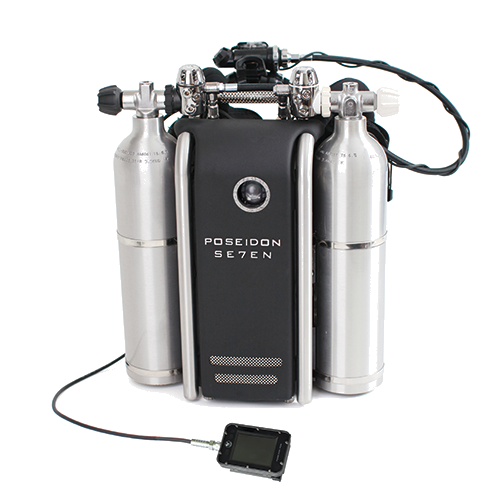
Getting Started
How much does a Poseidon rebreather cost?
The sticker price is only part of the picture. For most divers in the US, a realistic total budget for getting into a Poseidon Se7en+ is about $15,000 to $20,000 once training, supporting equipment, and sometimes travel are included. The exact number depends on configuration, what gear can be reused, and whether training requires a trip.
What is the difference between the Discovery MkVI, the Se7en, and the Se7en+?
Released in 2006, the Discovery MkVI was the original Poseidon-branded mass-production rebreather aimed at the sport diving market. The Se7en Classic, introduced in 2012, expanded the platform’s capabilities into extended-range technical diving while also improving field serviceability with detachable components such as the HUD, pressure sensors, and handset. It also introduced more capable electronics, including support for Bluetooth, CANbus connectivity, and hypoxic trimix diluents. Introduced in 2020, the Se7en+ retained the core Se7en platform but updated the electronics module to add native support for Poseidon’s Solid State Oxygen Sensor and an improved pneumatic block.
Can an old Discovery MkVI be upgraded to the new Se7en?
No. Although Poseidon offered an upgrade path for MkVI owners for several years after the Se7en was introduced, that option is no longer available. Original MkVI units still appear on the used market, but they are generally a poor value regardless of resale price. If you’ve got a MkVI and are still diving it, that is a testament to the platform’s longevity and durability. But the design is over twenty years old, has reached end-of-life, and is no longer economical to repair.
Can a Se7en Classic be updated to the Se7en+ version?
Yes. A Se7en Classic can be updated in the field to Se7en+ specification by replacing the e-module, but there is no official factory upgrade or trade-in program like the earlier MkVI-to-Se7en transition. The main reason to update is to gain native support for Poseidon’s Solid State Oxygen Sensor. Once the required electronics and sensors are included, however, the upgrade becomes expensive, and most divers conclude it makes more sense to buy a new Se7en+ and sell the Classic.
Acquisition & Training
How long does it take to get a Se7en+ rebreather?
In the US, the Se7en+ Core quick-ship configuration is now available within two to three days of ordering. Short stock-outs can occur, but delays longer than about 30 days are rare. Accessories and spare parts are available for immediate shipment.
What is the rebreather training time and cost?
Training standards vary by agency, but a full Poseidon CCR Diver certification course that meets industry requirements usually takes about five days, including academics, confined water, and open water dives.4 In the US, individual instruction costs about $1,500 to $2,500, depending on the instructor, location, and training center.
Can I buy the rebreather without training?
Yes, but it cannot be dived until the purchaser completes formal model-specific training. As with any rebreather, ordinary open-circuit training is not sufficient. If the purchaser is not already a certified Poseidon CCR Diver, authorized Poseidon dealers will deliver the Smart Module only to an approved Poseidon CCR Instructor nominated by the purchaser. Without the Smart Module, the unit is not diveable, and the instructor normally supplies it to the student when the class begins.
Maintenance & Operating Costs
How much does routine maintenance cost?
Routine maintenance should be budgeted at about $1,000 every two years, including the required periodic service and smaller ongoing consumable costs such as lubricant and disinfectant. The unit requires full service every 24 months.3
What consumables are recommended?
Commonly used consumables in the US include Molecular Products Sofnolime Grade 797 loose 8-12 mesh granular carbon dioxide absorbent, which aligns with the system’s original design and performance characteristics and with the manufacturer’s specified requirement for 797 grade absorbent.3 Edwards-Councilor Steramine for sanitizing the breathing loop; Aerospace Lubricants Tribolube 71 O2 Compatible Lubricant for O-ring seals; and, for units still using analog sensors, compatible “R-22D” style galvanic oxygen sensors such as the Analytical Industries PSR-11-39-MD.
How much do the consumables cost?
As with all rebreathers, the main consumable cost is CO2 absorbent. A full {5.1 lb | 2.3 kg} self-pack granular absorbent load costs about $30 and is enough for several sport dives. Other consumable costs, such as gas fills, are comparatively minor. Consumables are a small part of the overall cost compared with the equipment, training, and related diving expenses such as boat charters and travel.
How long does the absorbent last?
If determining duration by wall-clock time only, the manufacturer-rated absorbent duration is three hours in cold-water. Experienced divers report longer durations under controlled conditions based on monitoring oxygen consumption, but those observations are highly dependent on workload, temperature, and absorbent packing quality and should not be used for planning. Actual duration depends on the diver and dive conditions, and these observations do not supersede manufacturer guidance. When in doubt, discard the used absorbent and repack the cartridge with fresh absorbent.
What about the possibility of a 'caustic cocktail' with the rebreather?
For properly trained divers, inhaling a mixture of CO2 absorbent and water while diving is unlikely. The Se7en is a modern CCR design with several features to manage and remove water from the breathing loop. The "caustic cocktail" concern is largely a legacy fear from an earlier era of rebreather diving and is overstated compared to the realities of modern CCR design.
How available is the absorbent?
Suitable absorbent is widely available through dive shops and by online order for delivery to the diver or travel destination. As a result, supply logistics are less of a concern than they once were. Current Poseidon units have a reusable self-pack scrubber cartridge that is included with new units.
System Design & Electronics
What about Solid State Oxygen Sensors?
Poseidon now recommends that the Se7en+ be configured with at least one Solid State Oxygen Sensor as the primary. The Se7en+ can use traditional analog galvanic oxygen sensors, Poseidon Solid State Oxygen Sensors (SSO2), or both.3 Compared with galvanic sensors, the SSO2 offers improved speed, stability, and reliability of oxygen measurement and is not a routine replacement item. Based on what is known so far, service life is at least ten years, although the long-term field record is still developing. The tradeoff is up-front cost, since an SSO2 is roughly six to eight times more expensive than a galvanic sensor that requires annual replacement.
Does the Se7en have a CO2 monitor?
No. The Se7en does not include a CO2 monitor. Carbon dioxide monitoring is still a developing area in recreational rebreathers, and its practical value is debatable. It is important not to confuse a CO2 monitor with a breathing loop temperature monitor, which does not provide information or warning about actual carbon dioxide levels in the loop.
What is the Smart Module?
The Smart Module powers the rebreather electronics and enables the software features that determine the unit’s depth and diving capability. Poseidon originally offered several Smart Module versions, identified by color, corresponding to different levels of diving capability. All new Se7en+ units now include the Deep (aka Black) Smart Module, which has no depth, decompression, or gas-mixture restrictions.
Configuration Choices
Which style of counterlungs should I choose?
Front-mounted counterlung (FMCL, also called over-the-shoulder or OTS) and back-mounted counterlung (BMCL) configurations each involve tradeoffs, so the best choice depends on the diver’s priorities. Professional photographers often prefer back-mounted counterlungs in sport depths, but for most divers focused on overall performance, the larger-volume over-the-shoulder front-mount technical counterlungs are the more common choice.
What about manual addition gas valves?
Manual addition valves are optional on Poseidon rebreathers, but most divers want them, and most training standards assume the rebreather is equipped with them. In practice, that means they are part of the expected configuration for most divers. Poseidon offers a MAV pack using independently configured push-button valves attached to the breathing loop hoses, which works with all available counterlung configurations. The over-the-shoulder front-mount technical counterlungs also allow manual addition valves to be installed directly on the counterlungs in a more traditional arrangement.
What BC should I use with the Se7en?
The Poseidon rebreather works with ordinary BCDs that use standard tank straps, and with the QMR option the Se7en also supports most harness, backplate, and wing (BPW) systems that mount on standard 11-inch centers. A BPW-style configuration is by far the most common choice. A wing designed specifically for rebreather use is recommended in order to minimize volume around the neck and head area. A minimum buoyancy of about {30 lbs | 150 N} is sufficient for many configurations, although actual lift requirements depend on the diver’s exposure protection and equipment setup. Poseidon also offers its own harness, plate, and CCR-style wing for divers who want a single-vendor solution.
What cylinders should I use?
The Se7en uses a pair of small 4-inch diameter cylinders with inline-style DIN valves, although left- and right-hand valve orientations will also work. The oxygen cylinder and valve must be oxygen compatible and oxygen clean. Aluminum 13 or 19 cubic foot (2 L or 3 L) cylinders minimize total weight, while steel 17 or 23 cubic foot (2 L or 3 L) cylinders are commonly used. For many wetsuit divers, steel cylinders require little or no additional ballast, and trim can be fine-tuned with small adjustments to cylinder height.
What about the carrying handle, stand, and back cover?
These items are optional. The aluminum carrying handle is strongly recommended because it also helps protect the CANbus cable connections on the electronics module. The stainless stand is a popular addition when the unit is configured with cylinder inversion, although it adds about {4 lbs | 2 kg} to the total weight and may make the unit feel butt-heavy for light wetsuit divers. The back cover is primarily cosmetic, but it also provides some impact and abrasion protection during transport.
What bailout should I use?
Although the Poseidon rebreather includes an open-circuit diluent bailout valve (BOV), carrying an independent off-board bailout gas supply and regulator on all dives is strongly recommended. Most course standards require an off-board bailout cylinder, and carrying off-board bailout is considered best practice. Experienced rebreather divers often sidemount their off-board bailout, along with a compact SPG and a low-pressure hose fitted with a quick-connect compatible with the BCD power inflator and diluent MAV.
What Se7en options are recommended for technical diving?
The Se7en technical diving configuration includes the M28 dive computer connected by CANbus, the Deep Smart Module, oxygen and diluent manual addition valves, and cylinder inversion. A third oxygen sensor and a compatible backup dive computer for independent loop PO2 monitoring are recommended.
What about the use of in-line gas shutoff valves?
For technical diving, an in-line gas shutoff valve on the ADV/BOV diluent supply immediately adjacent to the mouthpiece is worth serious consideration. To be clear, this applies to the ADV/BOV diluent supply only. Poseidon does not recommend in-line shutoff valves on the oxygen supply or elsewhere in the diluent supply.
Diving Capability
How much does the Se7en weigh?
The rebreather weight is comparable to an open-circuit setup. A ready-to-dive Poseidon Se7en with absorbent has a dry weight of about {40 lbs | 18 kg} in a tropical wetsuit sport-diving configuration and is set up to be neutral to slightly buoyant in the water, depending on cylinder choice and weighting. Dry weight and in-water buoyancy vary considerably with configuration and with the counterlung volume maintained by the diver. A heavily configured Se7en for technical diving in a drysuit may weigh {50 lbs | 23 kg} or more and can be significantly negative in the water.
What is the Se7en maximum dive time and depth?
Rebreathers carry many hours of breathing gas regardless of depth, so dive time is seldom limited by gas volume. The Se7en diver is more often limited by CO2 absorbent duration, so multi-hour runtime dives are routine for properly trained divers operating within planned limits. As with open-circuit nitrox diving, decompression obligation and oxygen exposure must also be monitored and often become limiting factors depending on the dive profile. Poseidon rebreathers are suitable for all sport diving depths, and the Se7en with the Deep Smart Module has been qualified to a depth of {330 feet | 100 meters}.3 Although the Se7en can function well beyond sport diving limits, doing so requires substantial additional training and planning.
Is the Se7en capable of planned decompression diving with mixed gases?
Yes. With the Deep Smart Module, the Se7en can use nitrox or trimix diluents, including hyperoxic, normoxic, and hypoxic mixes, provided the diver is properly trained and the system is configured appropriately for the dive. Because the Se7en is a fully closed-circuit design, the use of mixed-gas diluents is much less expensive than in open-circuit diving. The Poseidon rebreather and M28 dive computer use a version of the DCAP decompression algorithm, which is based on inspired gas values and is well suited to closed-circuit rebreathers. Use of anything other than normoxic diluent, or diving outside recreational sport diving limits, requires substantial additional training.
Operational Considerations
Does the rebreather take a long time to maintain?
Rebreathers do require more disciplined attention than open-circuit equipment, so divers spend more time on maintenance. For divers who already maintain their open-circuit equipment carefully and consistently, the additional burden is modest rather than excessive.
Is the Poseidon rebreather Power-On-Self-Test troublesome?
No. On current Se7en units, the POST is not considered troublesome and takes less than three minutes from power-on to ready-to-dive. Much of the reputation comes from early Discovery MkVI behavior, particularly around the positive-pressure test and sensor validation, rather than from current Se7en performance. Properly trained Poseidon divers can expect the unit to pass the POST reliably.
How well does the Poseidon rebreather travel?
The Poseidon rebreather is travel-friendly. A key design goal was to minimize size and weight. As with any rebreather, cylinders are usually the more inconvenient part of travel, since they may be closely inspected by security personnel and are sometimes confiscated. For that reason, divers often rent cylinders at the destination or ship them ahead.
How is the Poseidon different from other rebreathers?
All rebreathers from established manufacturers are competent machines, but each makes more sense for some divers and some kinds of diving than for others. What sets the Poseidon Se7en apart is its level of automation, its solid state oxygen sensor technology, and the fact that it can take a diver from sport use into technical diving without changing platforms. It is also simpler to operate, without giving up capability or redundancy.
Is the Poseidon rebreather safe?
The Poseidon Se7en+ has important safety features, including automated pre-dive procedures, auto-calibration, and audible, tactile, and visual warning systems. No rebreather is foolproof, and safe use depends primarily on the diver. As with rebreather diving generally, diver error and inattention are major contributors to incidents, which is why training quality, operating discipline, and sound judgment matter so much. Always follow the manufacturer’s guidance and seek instruction from an authorized Poseidon Se7en+ Instructor.
Summary
The Poseidon Se7en+ is an established closed-circuit rebreather for both sport and technical diving. Its strongest points are its level of automation, its solid state oxygen sensor technology, and a design that has proven reliable in the field. Whether it is the right choice depends less on features and more on how the diver plans to use it. As with any rebreather, success depends far more on training and discipline than on the machine itself.